What Information Do You Need for a Custom Gear and Shaft Quote? A Buyer’s Checklist
When requesting a custom gear quote, many buyers send only a product photo, a rough drawing, or a message saying, “Please give me your best price.”
That may be enough for a rough budget estimate, but it is rarely enough for an accurate manufacturing quotation.
About Us – Changzhou Qiming Precision Machinery Co., Ltd
For custom gears, gear shafts, transmission shafts, and other precision mechanical components, the quotation depends on much more than the product’s outside dimensions. Material, gear geometry, tolerances, heat treatment, surface finish, quantity, inspection requirements, and production processes can all affect the final cost.
Providing complete information at the RFQ stage helps a manufacturer understand your requirements, recommend an appropriate manufacturing process, and provide a more reliable quotation.

At Changzhou Qiming Precision Machinery Co., Ltd., we support overseas buyers with custom gears, gear shafts, transmission shafts, and CNC-machined mechanical components based on engineering drawings, samples, and technical specifications.
This guide explains exactly what information you should prepare before requesting a custom gear and shaft quote.
Why Does a Custom Gear Quote Need So Much Information?
A custom gear is not simply a piece of machined steel.
The manufacturing cost may involve:
- Raw material
- CNC machining
- Gear cutting
- Turning
- Milling
- Heat treatment
- Grinding
- Surface treatment
- Inspection
- Tooling
- Packaging
- Production quantity
Two gears that look almost identical in a photograph can have significantly different manufacturing costs if their materials, tolerances, gear accuracy, or heat-treatment requirements are different.
For this reason, a professional custom gear manufacturer will normally need technical information before confirming a final quotation.
Basic RFQ Information at a Glance
| Information | Why It Matters | Example |
|---|---|---|
| Engineering Drawing | Defines geometry and tolerances | PDF / DWG / DXF |
| 3D CAD File | Helps understand complex geometry | STEP / STP |
| Gear Type | Determines manufacturing process | Spur / Helical / Bevel |
| Material | Affects cost and performance | 40Cr / 4140 / 42CrMo |
| Quantity | Determines production economics | 10 / 500 / 5,000 pcs |
| Gear Parameters | Defines tooth geometry | Module / Teeth / Pressure Angle |
| Tolerances | Determines machining requirements | Drawing-specific |
| Heat Treatment | Affects strength and cost | Carburizing / Nitriding |
| Surface Finish | Determines final processing | Grinding / Coating |
| Inspection | Defines QC requirements | Dimensional / Gear inspection |
| Delivery | Affects production planning | Required delivery date |
The more complete this information is, the more accurately the manufacturer can evaluate your project.
1. Send a 2D Engineering Drawing Whenever Possible
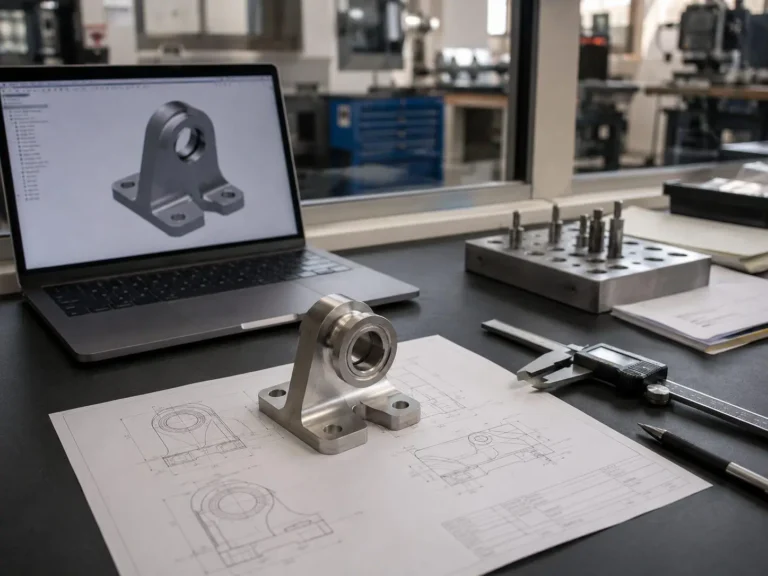
The most useful document for a custom gear quote is usually a detailed engineering drawing.
A good drawing should show:
- Overall dimensions
- Gear dimensions
- Number of teeth
- Module or diametral pitch
- Pressure angle
- Helix angle, if applicable
- Shaft diameters
- Keyways
- Threads
- Tolerances
- Surface roughness
- Material
- Heat-treatment requirements
- Surface-treatment requirements
A PDF drawing is often sufficient for an initial quotation.
For more complex components, a native CAD file can help the manufacturer understand the geometry and identify potential manufacturing issues.
2. Provide a 3D CAD File for Complex Components
For a simple spur gear, a 2D drawing may contain enough information.
However, a custom gear shaft with multiple diameters, keyways, grooves, holes, shoulders, and integrated gears can be much easier to understand from a 3D model.
Common formats include:
- STEP
- STP
- IGES
- Parasolid
- SolidWorks files
A 3D CAD file should supplement—not replace—the engineering drawing.
The drawing should remain the primary source for dimensions, tolerances, material, and inspection requirements unless otherwise agreed.
3. Specify the Gear Type and Basic Geometry
The manufacturer needs to know what type of gear you are sourcing.
Common types include:
| Gear Type | Typical Application |
|---|---|
| Spur Gear | Parallel-shaft transmission |
| Helical Gear | Industrial gearboxes and reducers |
| Bevel Gear | Intersecting shafts |
| Worm Gear | High reduction applications |
| Internal Gear | Planetary and compact transmissions |
| Gear Shaft | Integrated gear and shaft assemblies |
For a quotation, useful gear parameters may include:
- Number of teeth
- Module
- Diametral pitch
- Pressure angle
- Helix angle
- Pitch diameter
- Outside diameter
- Face width
- Gear accuracy
- Tooth thickness
These parameters directly influence the manufacturing process and tooling requirements.
4. Tell the Manufacturer the Material
Material is one of the most important factors in a gear manufacturing quote.
Common materials include:
- 40Cr
- 42CrMo
- 4140
- 4340
- 20CrMo
- 20CrMnTi
- 45 Steel
- Stainless steel
Different materials have different machining characteristics, mechanical properties, and heat-treatment requirements.
For example, a gear designed for heavy transmission loads may require a different alloy and heat treatment from a low-load machinery component.
If your engineering team has already specified the material, provide the exact grade rather than simply saying:
“Carbon steel.”
If material selection is still open, tell the manufacturer the application, load, speed, and operating environment so the engineering team can recommend a suitable option.
5. Clearly Define Quantity and Expected Annual Demand
Quantity can have a significant impact on the quotation.
A supplier may need to consider:
- Material purchasing
- Machine setup
- Tooling
- Programming
- Gear cutting
- Inspection
- Packaging
- Production efficiency
For example, a prototype order of 10 pieces and a repeat production order of 5,000 pieces may require very different production strategies.
Therefore, when requesting a custom gear and shaft quote, provide both:
Current order quantity
and, if possible:
Estimated annual demand.
This helps the manufacturer evaluate whether a dedicated tooling or optimized production process makes economic sense.
6. Specify Critical Tolerances
Not every dimension on a gear drawing needs the same tolerance.
Pay particular attention to:
- Gear tooth accuracy
- Shaft diameters
- Bearing seats
- Concentricity
- Runout
- Keyway position
- Gear-to-shaft alignment
- Surface roughness
For cylindrical involute gears, ISO 1328-1 provides a standardized framework for classifying gear flank deviations and tolerances.
However, buyers should avoid simply writing:
“High precision.”
A much better approach is to provide the actual tolerance requirement or applicable standard.
This allows the manufacturer to determine the appropriate machining and inspection process.
7. Specify Heat Treatment Requirements
Heat treatment can significantly affect both performance and manufacturing cost.
Common processes include:
- Carburizing
- Quenching
- Tempering
- Induction hardening
- Nitriding
For example, a transmission gear may require a hard wear-resistant surface while retaining sufficient core toughness.
If your drawing specifies heat treatment, include:
- Treatment method
- Surface hardness
- Core hardness, if required
- Case depth, if applicable
- Relevant standard
If you don’t have a defined heat-treatment specification, provide the operating conditions and intended application.
A professional manufacturer can then discuss suitable options with you.
8. Tell the Manufacturer About Surface Treatment and Finish
Surface requirements can also affect your gear machining quotation.
Potential requirements include:
- Grinding
- Polishing
- Black oxide
- Phosphate
- Zinc plating
- Nickel plating
- Other specified coatings
For machined surfaces, surface roughness requirements such as Ra may also be specified on the engineering drawing.
Not every gear needs the same finish.
A non-functional external surface may have relatively standard machining requirements, while bearing seats, sealing surfaces, and gear flanks may require much tighter control.
9. Define Your Inspection Requirements
If the component is critical to your machinery, specify your quality requirements before receiving the quotation.
Possible inspection requirements include:
| Inspection | Purpose |
|---|---|
| Dimensional Inspection | Verify critical dimensions |
| CMM Inspection | Verify complex geometry and positions |
| Gear Measurement | Check tooth geometry |
| Hardness Testing | Verify heat treatment |
| Surface Roughness | Verify functional surfaces |
| Runout Measurement | Verify rotational accuracy |
| Material Certificate | Confirm material grade |
| First Article Inspection | Approve initial production |
This is especially important for OEM buyers because inspection requirements can affect manufacturing cost and lead time.
10. Tell the Manufacturer How the Part Will Be Used
This is one of the most useful pieces of information that buyers often leave out.
A manufacturer can better understand your requirements if you explain:
- What machine uses the component?
- What is the operating speed?
- What load does it transmit?
- What environment does it operate in?
- Is low noise important?
- Is the component safety-critical?
- What mating component does it work with?
- Is it a prototype or a replacement part?
For example:
“This gear shaft is used in an industrial speed reducer operating continuously under moderate load.”
is much more useful than:
“Please quote this gear shaft.”
Application information helps the manufacturer understand which specifications are functionally important.
11. Provide Your Target Delivery Date
Lead time depends on several variables:
Drawing review → Material sourcing → Machining → Gear cutting → Heat treatment → Grinding → Inspection → Packaging
If your project has a fixed launch date, tell the manufacturer at the RFQ stage.
You should also distinguish between:
- Prototype delivery
- First production batch
- Repeat-order lead time
This allows the supplier to provide a realistic production schedule rather than simply promising the fastest possible delivery.
12. What Should a Complete Custom Gear RFQ Include?
A professional RFQ can be summarized in one checklist:
| Category | Information to Provide |
|---|---|
| Product | Gear / Gear Shaft / Transmission Shaft |
| Drawing | PDF + CAD if available |
| Gear Type | Spur / Helical / Bevel / etc. |
| Material | Exact material grade |
| Quantity | Current + estimated annual demand |
| Gear Data | Teeth / module / pressure angle / helix |
| Tolerances | Critical dimensions and gear accuracy |
| Heat Treatment | Process + hardness |
| Surface Finish | Roughness / coating |
| Inspection | Required reports and standards |
| Application | Machine and operating conditions |
| Packaging | Special requirements |
| Delivery | Required date / destination |
With this information, a manufacturer can move much faster from RFQ → technical review → quotation → sample → production.
How Changzhou Qiming Precision Machinery Helps Overseas Buyers

At Changzhou Qiming Precision Machinery Co., Ltd., we understand that international buyers often have different levels of technical information available when they begin sourcing.
Some customers have complete engineering drawings.
Others have:
- Existing samples
- 3D models
- Product photographs
- Old supplier drawings
- Basic dimensions
- Application requirements
Our role is to review the available information and clarify the manufacturing requirements before production.
Our advantages include:
Drawing-Based OEM Manufacturing
We support custom gears, gear shafts, transmission shafts, and machinery components according to customer drawings and specifications.
CNC Machining Support
Our manufacturing capabilities support CNC turning, milling, drilling, gear-related machining, and other precision manufacturing processes according to project requirements.
Multiple Mechanical Components
Instead of sourcing only one individual gear, overseas buyers can discuss related gears, shafts, transmission components, and machinery parts within the same manufacturing relationship.
Flexible Customization
Different projects require different materials, dimensions, tolerances, heat treatment, and surface finishing. We focus on customized manufacturing rather than only standard catalog products.
Technical Communication
Before quoting, we encourage buyers to provide as much technical information as possible. This helps identify missing specifications and reduces misunderstandings later in production.
Export-Oriented Service
We support overseas customers with quotation communication, production coordination, quality documentation, packaging, and international order requirements.
What If You Don’t Have a Complete Drawing?
Don’t assume you cannot request a quote.
If you don’t have a complete engineering drawing, you can provide:
- Product photos
- Physical samples
- Basic dimensions
- 3D models
- Existing supplier information
- Gear parameters
- Application information
The manufacturer can then determine what additional information is required before preparing a final quotation.
However, for high-precision custom components, a complete engineering drawing is strongly recommended before mass production.
FAQ About Custom Gear and Shaft Quotes
1. What information do I need for a custom gear quote?
At minimum, provide the gear type, drawing or dimensions, material, quantity, gear specifications, tolerances, heat treatment, surface finish, and delivery requirements.
2. Can I get a quote without an engineering drawing?
Yes, an initial budgetary quotation may be possible using photos, samples, dimensions, or 3D models. A final production quotation normally requires more complete technical information.
3. What file format should I send for a custom gear?
PDF drawings are commonly useful for quotation and technical review. STEP or STP files are recommended when a 3D CAD model is available.
4. What information is needed for a gear shaft quotation?
For a gear shaft, provide the shaft dimensions, gear parameters, material, tolerances, keyways or splines, heat treatment, surface finish, quantity, and application requirements.
5. Does quantity affect the gear quotation?
Yes. Production quantity can affect material purchasing, machine setup, tooling, processing efficiency, inspection, and packaging costs.
6. Should I specify the gear accuracy?
Yes. If the gear is used in a precision transmission system, the required gear accuracy should be clearly defined through the drawing or applicable standard.
7. Can Changzhou Qiming manufacture custom gears from samples?
Custom manufacturing can be evaluated using physical samples, drawings, CAD files, or other technical information. For production, the final specifications should be confirmed and approved before manufacturing.
8. How can I get a more accurate quotation?
Provide the drawing, material, quantity, gear specifications, tolerances, heat treatment, surface requirements, inspection requirements, and application information. Complete information allows the manufacturer to calculate the manufacturing process more accurately.
Get a Custom Gear & Shaft Quote
A good quotation starts with good technical information.
Whether you need a single prototype, a small production run, or a long-term OEM supply of custom gears and shafts, providing complete information at the beginning can save time for both the buyer and manufacturer.
Changzhou Qiming Precision Machinery Co., Ltd. supports overseas customers looking for custom gears, gear shafts, transmission shafts, and precision mechanical components.
Send us your:
2D drawing + 3D CAD file + material + quantity + technical requirements
and our team can review your project and discuss a suitable manufacturing solution.
From engineering drawing to finished component, we focus on turning your technical requirements into practical manufacturing solutions.